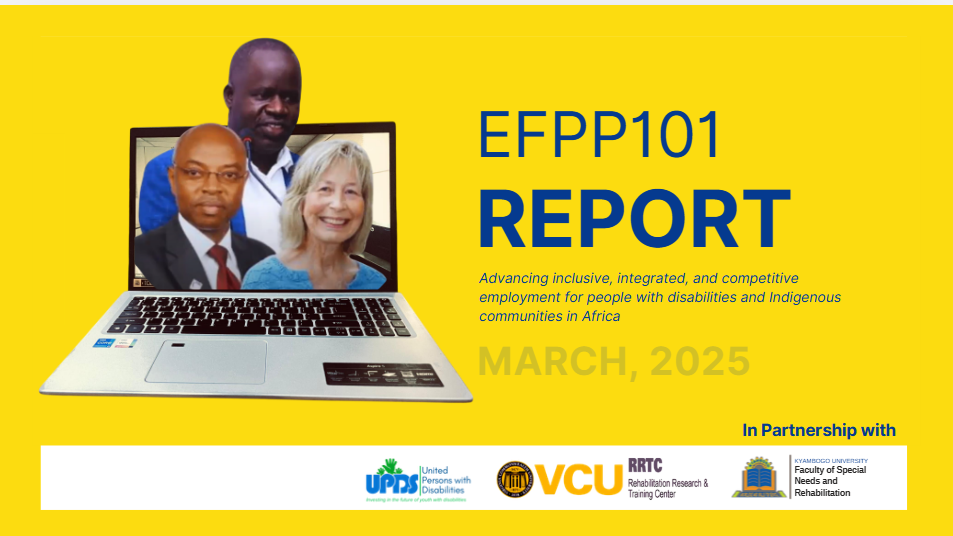
The report presents the implementation, outcomes, and lessons of the Employment First Policy and Practice Course (EFPP101), which engaged 150 participants across 15 countries.
The Employment First Policy and Practice Course (EFPP101) was designed to advance meaningful employment and economic participation for people with disabilities, especially in low- and middle-income countries. The inaugural cohort engaged youth and adults with disabilities, self-advocates, university students, emerging entrepreneurs, and employers, reaching 150 participants from 15 countries.
Delivered online in collaboration with Kyambogo University and Virginia Commonwealth University, the course combined expert lectures, independent learning, mentorship, leadership development, team-building and participant-led capstone/community projects.
More than 85% of participants demonstrated improved and sustained outcomes in areas including workplace readiness, entrepreneurship, social-emotional development, and policy advocacy. Participants also strengthened practical skills such as public speaking and project planning.
Lead and institutional contributors: United Persons with Disabilities (UPDS); Faculty of Special Needs and Rehabilitation, Kyambogo University; and Virginia Commonwealth University Rehabilitation Research and Training Center (VCU-RRTC).
Course leadership and contributors included: Harunah Damba, Dr. Wendy Parent-Johnson, Dr. Patrick Ojok, Denis Ouma, Professor Augustus Nuwagaba, Alissa Brooke, Nery Birdsell, Elizabeth Rwabu, Jenn McDonough, Dr. Whitney Ham, Rachael Rounds, Crystal Hence, Joshua Drywater, Dr. Lauren Avelone, Lucian Friel, and other participating experts and panellists. The report documents their contributions across employment policy, person-centred planning, employer engagement, job supports, entrepreneurship, economic policy and impact assessment.
EFPP101 demonstrated the value of bringing together lived experience, academic expertise, and grassroots leadership to advance disability-inclusive employment. Beyond knowledge transfer, the programme created connections, strengthened confidence, and equipped participants to translate learning into locally relevant community initiatives.
“If we're looking at employment, then our question is NOT, ‘Can they work?’ but rather, ‘What do they want to do?’” - Dr. Wendy Parent-Johnson
Help us improve your experience on the UPDS website.